Tuesday, August 21, 2007

Zimbel's Hypothesis of 21-08-2007 21:16


If the above is true, that gives us:

Boleh saya katakan, hampir tiada tanda jalan yang jelas bagi menunjuk arah ke sesuatu destinasi. Bagi saya yang pertama kali memandu di Kuching, amat memerlukan penunjuk arah itu -- ketiadaan papan tanda yang jelas ini membuatkan saya berfikir, seolah-olah saya sedang memandu di sebuah kampung yang penduduknya sudah pasti tahu ke mana destinasi mereka. Namun ia cukup tidak adil bagi mereka yang bukan orang tempatan.

Can I tell, almost no sign route that obvious for to hand over direction to like one is assigned. Give me that first times to guide at Kuching, very to need landmark direction that -- absent plank symbol that obvious this make again my thought, as if I am in the process of to guide at (like a number of large objects) village that (penduduknya) finished definite symbol to know to where it is assigned their. Yet it enough not fair for their who non-person local.

Dr. Zimbel's Treatise on Malay Syntax and Vocabulary, Chapter I


Keeping with a Malay dictionary approach,

Boleh saya katakan, hampir tiada tanda jalan yang jelas bagi menunjuk arah ke sesuatu destinasi. Bagi saya yang pertama kali memandu di Kuching, amat memerlukan penunjuk arah itu -- ketiadaan papan tanda yang jelas ini membuatkan saya berfikir, seolah-olah saya sedang memandu di sebuah kampung yang penduduknya sudah pasti tahu ke mana destinasi mereka. Namun ia cukup tidak adil bagi mereka yang bukan orang tempatan.

Note: in the case of a double-word, the prefix goes on the first instance, and the suffix on the last instance.

suffixes and prefixes with only one affirmation are followed by question marks. If there are at least 2 instances I've found with the same usage, I remove the question mark. In a few cases, I've found apparently contradictory instances.

Doubling a word sometimes means multiples (like sign language), but not always (?)

Prefixes:
Note: in some cases, these can be chained, like Japanese/German: memper- is an example.

be- having?
ber- to
berke-
ke- seperated?
mem- to? (note: can override first letter in root)
men- abstraction?
meng- in reference to another object/person? (note: can overwrite first letter of root)
pe- person?
per- a group? an individual?
pem- -ing in English? (note: can override first letter in root)
pen-
peng- person who?
se- like, such as I have X like person Y
sese- some?
ter- past tense?

Suffixes:
-an - changes adjective to noun.
- bulan - month?
-kan - inverse? again? to
-i
- hati
- imbas
- jadi - partial negation (such as changing can -> may)?
- kaki - with feet?
- letih - energy?
-nya - person did?
-pun
- rumah - female spouse?
- umur - age?
-nya - superlative?
- sekata - agree?


Words with question marks are guesses from roots.

Words with * are from Francis's research.

Words with + are from free.translated.net's Indonesian->English translator

Words with ++ are from kamus

adil -fair/just
amat -very
arah -direction
bagi -for/give
berfikir - to think (root firkir)
Boleh - can/able to
bukan - non-; not; doesn't
cukup - enough/exactly
destinasi - (in Italian, this is "it is assigned" - is this possibly a loan word?)
di - at
hampir - near/close/almost
ia -it/s(he)
ini -this
itu - that
jalan -road/way/route/walk
jelas -clear/well-defined/obvious
kali -times/multiply
kampung -village
katakan - tell/say/suppose (root kata)
ke - to+
ketiadaan - (++) absence/default/lack/non-existence/nothingness
Kuching - A specific city (*)
mana - where
memandu (++) -to guide/to pilot
memerlukan -(++)To need/take/took/entail/involve/require/deem necessary/claim/do with/necessitate
membuatkan (root is buat - make/do/perform) to make again? to make against?
menunjuk (mispelling of mengunjuk - to hold out/to hand over? In any case, the root, unjuk, is hold out/hand over)
mereka - they; them; their
Namun - yet; still
orang - person/people
papan - plank
penduduknya
penunjuk -helping hand/index/landmark/indexes (++)
pertama - first
pasti - definite/certain/sure
saya - I/my/me
sebuah - like fruit/like a number for large objects(?)
sedang - to be in the process of; average/sufficient
seolah-olah - as if (root olah)
sesuatu -like one/like a(?)
sudah - already/finished
tahu - to know/soya
tanda - sign/mark/symbol
tempatan - local
tiada - no/not/not any
tidak - no/not
yang - who/which/that

If the above is true, that gives us:
Boleh saya katakan, hampir tiada tanda jalan yang jelas bagi menunjuk arah ke sesuatu destinasi. Bagi saya yang pertama kali memandu di Kuching, amat memerlukan penunjuk arah itu -- ketiadaan papan tanda yang jelas ini membuatkan saya berfikir, seolah-olah saya sedang memandu di sebuah kampung yang penduduknya sudah pasti tahu ke mana destinasi mereka. Namun ia cukup tidak adil bagi mereka yang bukan orang tempatan.

Can I tell, almost no sign route that obvious for to hand over direction to like one is assigned. Give me that first times to guide at Kuching, very to need landmark direction that -- absent plank symbol that obvious this make again my thought, as if I am in the process of to guide at (like a number of large objects) village that (penduduknya) finished definite symbol to know to where it is assigned their. Yet it enough not fair for their who non-person local.

Monday, August 20, 2007

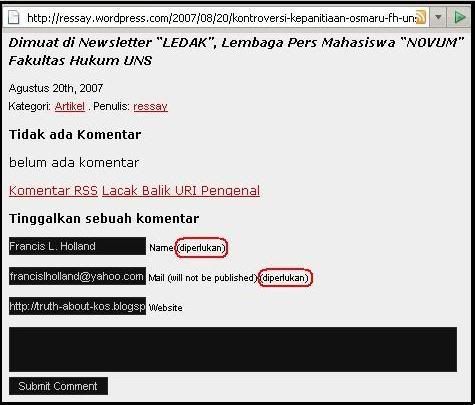
Komentar* = Comment* , to comment*


Photo Sharing and Video Hosting at Photobucket

"Komentar" means "comment, as in "post a comment."

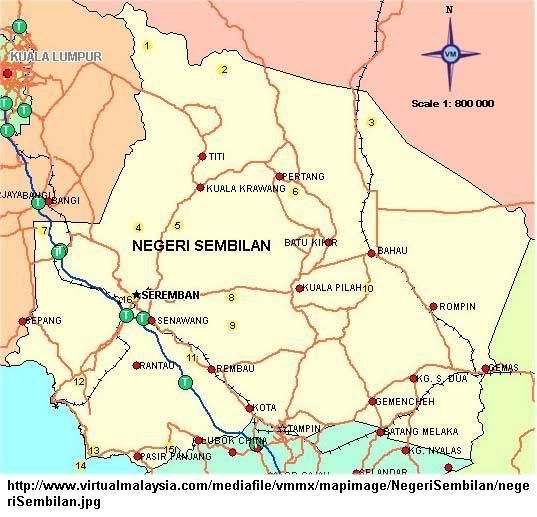
Negeri Semblian* = Nine States (a place in Malaysia)


Photo Sharing and Video Hosting at Photobucket
"Negeri Sembilan translated literally means "Nine States," so named because it comprises a federation of nine states. It is located on the south-west corner of Peninsular Malaysia and encompasses an area of 6,645 sq km including a 48-km gentle coastline. Seremban, the capital of Negeri Sembilan, is 64 km south of Kuala Lumpur.

Negeri Sembilan is noted for its Minangkabau-styled architecture, reflecting the influence of the State's first inhabitants from Sumatra." Geography.Com

Pemindang* = "material for preparing this dish"


The word "pemindangnya" appears in our target text. Although this word does not appear in Google, the word "pemindang" does. As Zimbel suggested, "nya" may be a suffix that has been added to the root word "pemindang."

The Babylon dictionary defines "pemindang" as:

"material for preparing this dish" Babylon

Interestingly, the word "memindang" is spelled just like "pemindang," except for the initial consonants.

Here, the word "pemindang" appears in a different context.

Universiti* = University*


Malaysia's "leading research university is called "Universiti Putra Malaysia," and so the word "universiti" must mean "university."

In linguistic terms, the decodification of cognates such as this is also known technically as "picking the low-hanging linguistic fruit." But, I hear that Universiti Putra Malaysia is an excellent university. It certainly has an excellent website, in Malay and English.

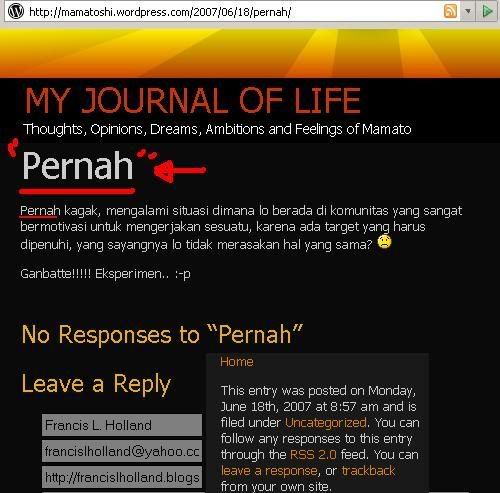
Pernah* Means?


Photo Sharing and Video Hosting at Photobucket

At the Mamatushi blog, we find this usage of the word "pernah:"

Pernah kagak, mengalami situasi dimana lo berada di komunitas yang sangat bermotivasi untuk mengerjakan sesuatu, karena ada target yang harus dipenuhi, yang sayangnya lo tidak merasakan hal yang sama? :-(

Ganbatte!!!!! Eksperimen.. :-p Mamatoshi

Salience:

The word "pernah" appears twice in the target text, e.g.:
Monumen kucingnya masih di situ, membatu di tengah-tengah bandaraya itu.
Waterfrontnya juga masih menjalankan aktiviti-aktiviti sama, bazar di seberang jalannya juga masih begitu menjual produk-produk kraf yang pernah saya lihat dulu.
Also see this usage by Mamatoshi, discussing a "critique of Infolinux:"
Website yang TIDAK PERNAH DIUPDATE. Websitenya tidak pernah mengalami upgrade software menjadi lebih baru, ataupun layout yang lebih baik. Perhatikan, Logo Website masih menunjukkan perayaan ulang tahun InfoLinux yang ke 5 ( tahun 2006!). Bandingkan dengan website majalah lain. Mamatoshi

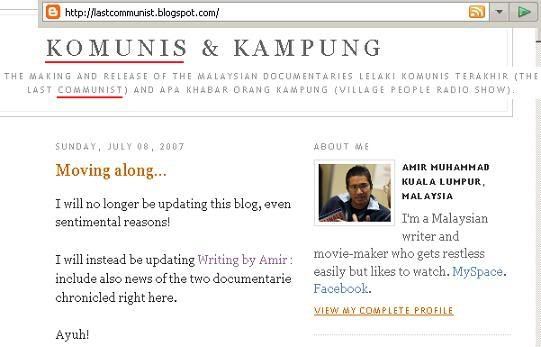
Komunis* = Communist*


Photo Sharing and Video Hosting at Photobucket

Komunis & Kampung

The word "komunis" seems to mean "communist," as in the "Lelaki Komunis Terakhir':" "The Last Communist."

If so, then the words "Lelaki" and "Terakhir" must mean either "last" or banning (?)

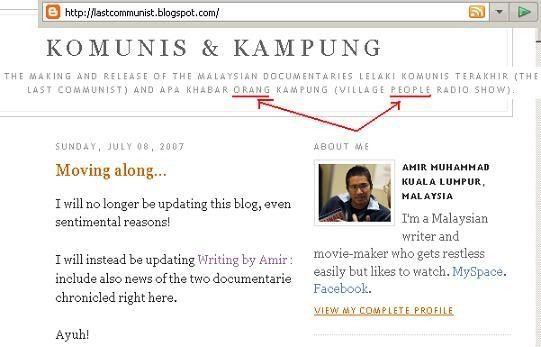
Orang* = Person* and/or People*


Photo Sharing and Video Hosting at Photobucket

Komunis & Kampung

Kraant says:
Orang is person.

Hutan is forest.

So what's an Orangutan?

If things seem too simple and it feels like you're missing something, don't worry. The language really is that easy to learn. Comments
"Orang" also seems to mean "people:"
Apa Khabar Orang Kampung (Village People Radio Show). Komunis & Kampung

Nama*


Kraant says,
"Nama saya Daniel."

Would mean IIRC from my very rusty memory mean:

"My name is Daniel."

"Nama kamu Francis."

Would mean:

"Your name is Francis."


Orang is person.

Hutan is forest.

So what's an Orangutan?

If things seem too simple and it feels like you're missing something, don't worry. The language really is that easy to learn. Comments

Kuching* - A City in Malaysia


Kuching is a place in Malaysia.

Kuching is the capital of the East Malaysian State of Sarawak. Kuching is the most populous city in the state of Sarawak (see CIA World Factbook w/map) and the fourth largest city in Malaysia[3].[4] Kuching was elevated to city status on 1 August 1988. ( . . .) Kuching is situated at the banks of the Sarawak River on the North-Western part of the island of Borneo. ( . . .) It was also voted as the healthiest and cleanest city in Malaysia, as well as in the World, which recognised and awarded by both United Nations (UN) and World Health Organisation (WHO) [9] and by the Alliance for Healthy Cities (AFHC) in Suzhou, China.[10] ( . . .) Kuching offers some of the world's greatest natural flora and fauna. With this, several international film makers have made their ways to Kuching and chosen Kuching as their filming location.Wikipedia: Kuching

Mission Statement of the Encyclopedia of the Kifli Language

The purpose of this encyclopedia is to discover the meaning of the essay posted by Zulkifli (Kifli) Bujang on August 18, 2007, entitled "Waterfront, (Kuching, Sarawak) 18th Ogos, 2007 ,"posted at his Behind the Scene blog. Zulkifli Bujang is best known by his nickname, "Kifli."

Since this is the first time that I have seen or heard any words in the target language, any presumption of knowing the name of the language would be pure supposition at this point. So, I will call the language in which Kifli's has written his Essay of August 18, 2007 the "Kifli Langauge," and I call this encyclopedia, the "Encyclopedia of the Kifli Language." Here is the target text of the Encyclopedia of the Kifli Language:
Kuchingku Kaku!

Waterfront, (Kuching, Sarawak) 18th Ogos, 2007 -- Kali pertama dan terakhir menjejakkan kaki ke pinggir sungai Sarawak yang berliku-liku ini ialah sekitar 7 tahun lalu. Waktu itu, masa banyak dihabiskan untuk bekerja--membuat penggambaran Selamat Pagi Malaysia (RTM), tapi hari ini saya kembali ke negeri itu lebih untuk merealisasikan impian orang-orang yang belum pernah ke Kuching.

Kuching pada saya, tidak banyak berubah, selain lapangan terbangnya yang sudah dinaiktaraf dan beberapa jejantas atau by-pass merentasi bandaraya itu, saya tidak dapat melihat apa-apa mercu tanda baru lain yang boleh mengaitkan bumi kenyalang itu sedang menuju ke arah sebuah negeri maju.

Monumen kucingnya masih di situ, membatu di tengah-tengah bandaraya itu.

Waterfrontnya juga masih menjalankan aktiviti-aktiviti sama, bazar di seberang jalannya juga masih begitu menjual produk-produk kraf yang pernah saya lihat dulu.

Kalau dulu di bazar seberang jalan inilah saya beli kain puah dan kayu pemindangnya, tapi kali ini, saya tidak berminat untuk membeli sebarang jenis perhiasan -- boleh jadi, konsep rumah saya kini tidak lagi sama dengan konsep etnik seperti itu.

Dua kali saya mudik ke seberang sungai, ke perkampungan Melayu, bayaran yang dikenakan penambangnya juga masih sama, 30 sen dan 50 sen bagi menyeberang ke tempat yang lebih jauh.

Suasana kerja-kerja menaiktaraf tempat-tempat awam ketika negara sedang menyambut Tahun Melawat Malasyia 2007, bukan lagi asing, ia sering diperkata di dalam akhbar terutama di tempat-tempat tumpuan pelancong.

Di sini, perkara sama juga saya lihat. Di Muzium Kucing misalnya, walaupun ia hanya melibatkan kerja-kerja pembaikan kecil, namun ia masih mengganggu urusan pelancong yang keluar masuk ke muzium itu.

Menyentuh mengenai urusan pelancong, perkara ini amat perlu saya kemukakan, soal tanda jalan atau penunjuk arah.

Boleh saya katakan, hampir tiada tanda jalan yang jelas bagi menunjuk arah ke sesuatu destinasi. Bagi saya yang pertama kali memandu di Kuching, amat memerlukan penunjuk arah itu -- ketiadaan papan tanda yang jelas ini membuatkan saya berfikir, seolah-olah saya sedang memandu di sebuah kampung yang penduduknya sudah pasti tahu ke mana destinasi mereka. Namun ia cukup tidak adil bagi mereka yang bukan orang tempatan.

Yang jelas, sesuatu perlu dilakukan bagi sebuah negeri berstatus bandaraya ini untuk terus maju.

Selamat menyambut Hari Kemerdekaan Malaysia ke-50!


This Encyclopedia will be a compendium of sources, resources, web pages, blogs, words and phrases, etcetera, that are seen useful at any point in the process of decodifying the target text in particular and the "Kifli Language" in general. :) (Please hear me laughing at myself at this point.)

Based on the fact that the word "Dihabiskan" appears 13 times in a text online at the Universiti Penyelidikan Yang Ulung di Malaysia (UPM), and considering that Malay is the official language of Malaysia, spoken by 50.4% of the population, I suspect that the "Kifli Language" may also be known as "Malay."

To simplify the task of decoding the words in the Kifli Essay, I will place these words in bold at the beginning of each discussion of them, and then eventually organize these words into alphabetical order. For the mean time, the search functions resident in whatever programs I and readers have will make it possible for us to find all instances of these use of each word within this text.